Hills and Centre
Between Dassa and Savalou, granite inselbergs, an active Yoruba royal palace and yam cultivation rhythm the central stage of the country.
The Hills form the geographical heart of Benin, halfway between Cotonou and the Nigerien border. The landscape shifts noticeably after Bohicon: the wooded savanna becomes rolling, and dozens of granite inselbergs rise above yam and cassava fields. These rocky domes, sometimes reaching 200 to 400 metres, give the region its name and visual identity. Dassa-Zoumè and Savalou are the two poles, some fifty kilometres apart, positioned on either side of the RN2 national road.
Dassa, capital of the Hills department, was built at the foot of these rocks. The town is known throughout the country for the Arigbo Marian grotto, a Catholic sanctuary carved beneath a granite boulder, which hosts a national pilgrimage every August 15th drawing tens of thousands of the faithful. For the rest of the year, the site remains open and peaceful, and locals readily climb the neighbouring summits for a few hours of walking, with clear views over the agricultural patchwork below.
Savalou, to the west, is one of the country's oldest royal capitals. The palace of the Mahi king, a dynasty of Yoruba origin, is still occupied and the current sovereign receives visitors according to protocol. The yam market, held mid-week, is among Benin's most important: Savalou is locally nicknamed the yam capital, and the yam festival in August marks the agricultural and ritual calendar. The Dankoli convent, some twenty kilometres to the north, is one of the principal voodoo worship sites in central Benin, where people come to leave offerings in exchange for a few coins and some local spirits.
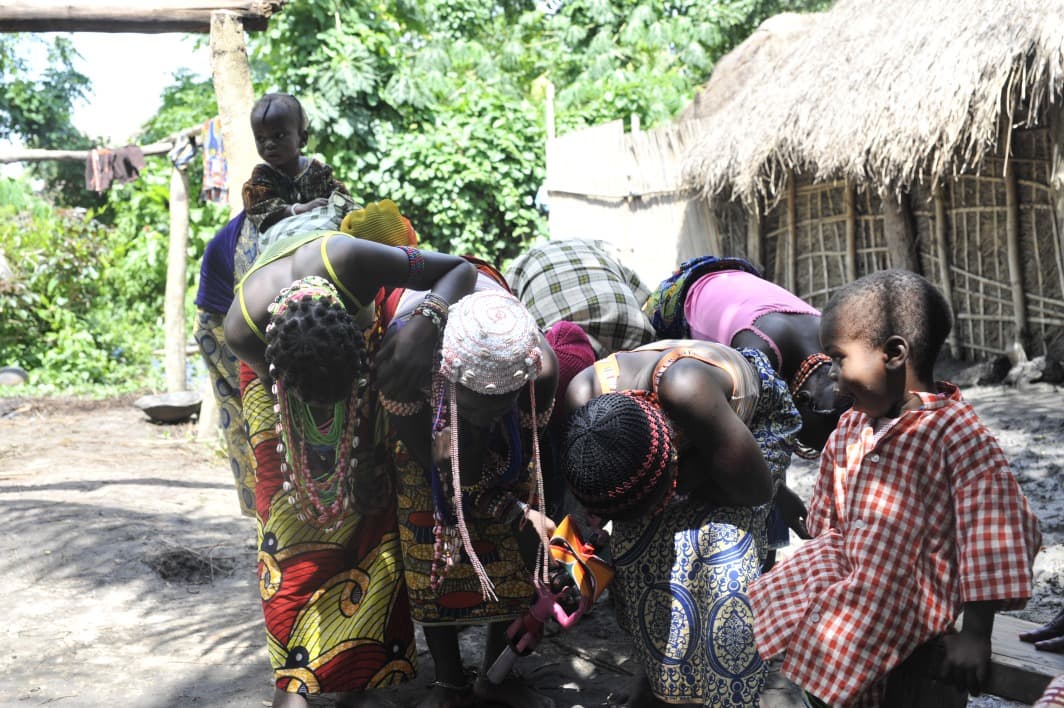
The region's population is mixed: Mahi, Idatcha, Ifè and Tchabè, all related to the Yoruba world, coexist with Fon communities from the south. This diversity is evident in languages, cuisines and religious practices, where Catholicism, Islam and voodoo coexist without visible tension. At table, one eats pounded yam accompanied by peanut sauce or glutinous okra sauce, and wagasi, fried Fulani cheese, appears on market stalls.
Climatically, one leaves the southern two-rainy-season regime for a transitional one, with a single well-marked dry season from November to February and a continuous rainy season from May to October. It is drier, hotter by day, cooler at night during the dry season. This transitional position makes it a logical stopping point on any itinerary connecting the coast to the country's north, and the density of experiences on site justifies two nights rather than a simple technical stop.
To discover
Climbing Okuta inselberg. A 45-minute ascent on granite slab above Dassa, with 360-degree views of other domes rising from the savanna. Best done early morning before the heat.
Arigbo Marian grotto. Catholic sanctuary set within a granite chaos at Dassa-Zoumè, peaceful outside the August 15th pilgrimage. Testifies to the religious syncretism of central Benin.
Savalou royal palace. Audience possible with the Mahi king in the active palace, after contact through our agency. The sovereign receives in formal dress, in the presence of his dignitaries.
Dankoli voodoo convent. One of central Benin's most frequented shrines, where anyone can make an offering after libation. Essential reading to understand voodoo beyond coastal imagery.
Savalou yam market. Piles of tubers 20 to 50 cm high, negotiated by Mahi women. Good terrain for grasping the real agricultural economy of the Hills, far from tourist stalls.
When to go
The best period to traverse the Hills runs from November to February. Secondary tracks to yam villages are passable, temperatures oscillate between 20 degrees at night and 32 to 34 degrees by day, and the air is dry. December and January sometimes see the harmattan blow, a dusty wind from the north that obscures horizons but significantly cools mornings.
From March to May, temperatures climb above 36 degrees and midday walking becomes difficult. The rainy season, from June to October, greens the landscapes and makes inselberg hikes slippery: granite rock is smooth and grip deteriorates quickly. August is a particular month, marked by the Arigbo pilgrimage and the Savalou yam festival: culturally intense period, but to plan ahead for accommodation.
Practical advice
We recommend two nights on site, ideally split between Dassa and Savalou, or both in Dassa with a day excursion to Savalou and Dankoli. The region is reached by road from Cotonou in 4 hours via the RN2, or from Parakou in 3 hours. There is no intermediate airport; access is always by vehicle. Accommodation remains simple: a few decent inns in Dassa, one or two guesthouses run by religious communities or private individuals, air conditioning not always guaranteed during power cuts.
The Hills fit naturally between the Abomey plateau to the south, 1.5 hours away, and Atakora or Pendjari to the north, 5 and 7 hours respectively. It is the respite stage on a 10 to 15-day south-north itinerary. The region suits travellers who enjoy half-day walks, are interested in local royalties and voodoo, and accept modest comfort in exchange for terrain little frequented by international tourism.