Kpassè Zoun Sacred Forest
Kpassè Zoun Sacred Forest
In Ouidah, the Kpassè Zoun sacred forest tells the legend of King Kpassè and shelters the sanctuaries of the voodoo pantheon's deities.
The Kpassè Zoun sacred forest in Ouidah holds a central place in Benin's voodoo memory. Over a few hectares, venerated trees, altars and sculptures tell the legend of King Kpassè and the cosmology of the voodoo pantheon. It is one of the most eloquent sites for understanding how, in the country's south, religion, royalty and nature have intertwined over the centuries.
Why visit the Kpassè Zoun sacred forest
Unlike a botanical garden or a closed museum, Kpassè Zoun is a living place of worship. The inhabitants of Ouidah maintain rites inherited from the Xwéda kingdom, and the forest functions as an open-air sanctuary. A visit, accompanied by a local guide, allows you to grasp the place of voodoo in Beninese daily life, without the folkloristic interpretation often associated with this religion.
The site complements other heritage sites in the city well, notably the Slave Route, which traces Ouidah's past as a slave trading port. Plan for half a day to visit both on foot or by motorcycle taxi.
History: the legend of King Kpassè
The forest takes its name from King Kpassè, sovereign of the Xwéda kingdom in the 17th century, who had established his power in the Ouidah region. According to oral tradition, Kpassè found himself threatened by the King of Abomey, who sought to extend his grip towards the coast. To escape his pursuers, he took refuge with his faithful followers in this forest and, at the foot of a great iroko tree, begged the tree to protect him. The trunk is said to have opened to absorb him, thus removing him from the sight of his enemies.
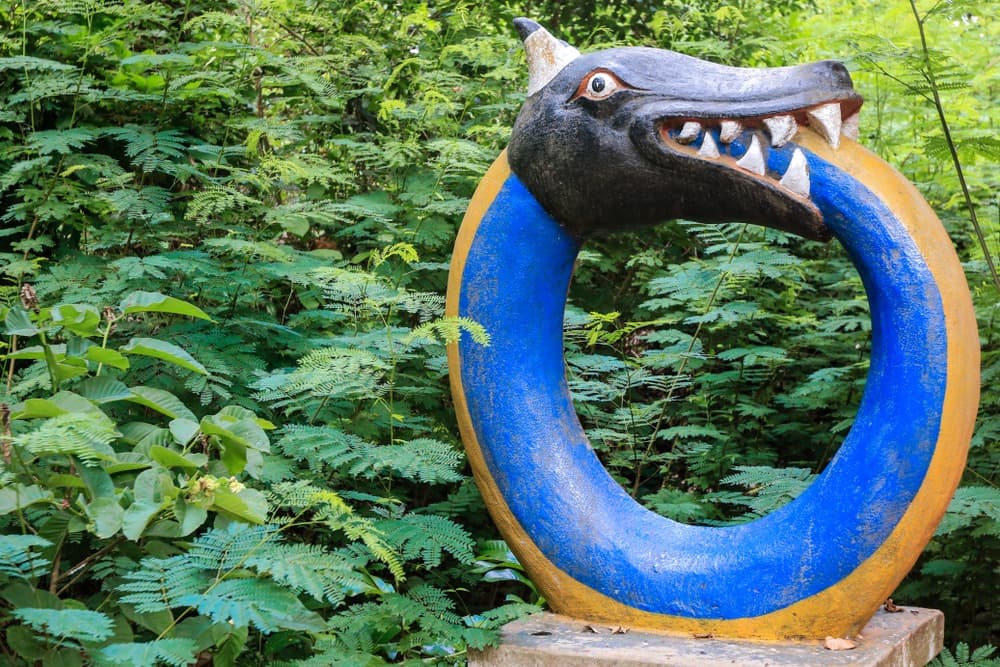
Later, Kpassè is said to have reappeared in the form of a serpent, becoming a protective spirit of the place. Since then, the iroko has been venerated as the king of trees and shelters the spirit of the sovereign. This legend establishes the sacred character of the forest and explains the omnipresence of the serpent in the sculptures and rituals of the site.
What to see on site
The iroko and remarkable trees
The central iroko is the most venerated tree. The faithful approach it to touch it, greet it or leave offerings. Beside it, a monumental silk-cotton tree houses the sanctuary of Sakpata, god of the earth linked to health and healing. Guides also point out baobabs and kapok trees, each associated with symbolic roles in local cosmology.
The sanctuaries of voodoo deities
- Mami Wata, goddess of water associated with fertility, beauty and wealth, is honoured near a pond. Offerings here take the form of flowers, perfumes and jewels.
- Sakpata, god of the earth linked to health, receives offerings of flour beneath his silk-cotton tree, sometimes blood or chickens depending on the ceremonies.
- Lègba, god of crossroads and guardian of thresholds, is found at the entrance to the forest. Traditional offerings include gin, corn or tobacco.
The sculptures
Several statues dot the trail. The wooden statue of King Kpassè stands at the foot of the iroko, surrounded by representations of serpents. A metal statue of Mami Wata can be found near the pond dedicated to her. An earth sculpture represents Queen Tassi Hangbé, a figure of the Dahomey kingdom who succeeded King Akaba in the 18th century. Finally, a stone python sculpture, adorned with pearls, sits on an altar of offerings and recalls the central place of the animal in local worship.
Ceremonies and rituals
Three key moments punctuate the life of the site:
- The Voodoo festival on 10 January, an official day in Benin, gives rise to parades, masks, songs and dances that bring together the faithful and visitors.
- The python ceremony, organised on the first Friday of each month, pays homage to the sacred animal of the forest.
- An initiation ceremony can be offered to those committed to the voodoo path: tests, ritual marks and a change of name mark the passage to initiated status.
On site, three figures guide the visitor's experience: the keeper, who protects and maintains the forest and grants access; the storyteller, keeper of the narratives linked to the site; and the healer, who draws on medicinal plants and rituals.
Practical information
- Site access: visits must be made with a guide affiliated to the forest. A modest entrance fee is charged, plus a customary tip for the guide.
- Dress code: covering clothing recommended (shoulders and knees), closed shoes for walking the trails.
- Photography: possible in most areas, but systematically ask permission before photographing altars, officiants or ceremonies.
- Offerings: if you wish to make one, your guide will indicate what is appropriate for each deity.
- Duration: allow 1 to 1.5 hours for a complete visit.
When to go
The dry season, from November to February, offers the most comfortable conditions: bearable temperatures, little rain and mosquitoes, and passable trails. The period around 10 January is particularly intense due to the Voodoo Festival, but also very busy. The rainy season, from March to October, makes the forest greener, at the cost of humid heat and sometimes muddy trails.
How to get there
Ouidah is located approximately 40 km west of Cotonou, which is home to the country's international airport. From Cotonou, count approximately 1 hour by car or shared minibus to reach Ouidah. The sacred forest is located in the city centre, accessible on foot from most accommodations or by motorcycle taxi for a few hundred CFA francs.
What to see nearby
- The Slave Route, a 4 km trail dotted with monuments leading to the Gate of No Return on the beach.
- The Python Temple, in the heart of Ouidah, where around sixty royal pythons live.
- The Egungun dance and Guèlèdè masks, other living expressions of southern Benin's traditions.
Frequently asked questions
Frequently asked questions
No. Access must be made with a local guide, who ensures respect for the site and explains the significance of the altars and sculptures. It is also a mark of respect for the officiants of the site.
There is no strict dress code, but modest and covering clothing is expected. Avoid very short shorts and tank tops, especially if you are attending a ceremony.
It is not mandatory for a tourist visit. If you wish to participate in a ritual or seek a favour from a deity, your guide will direct you towards an appropriate offering (alcohol, corn, cloth, etc.).
Planning your trip
The Kpassè Zoun sacred forest is part of a wider itinerary blending voodoo culture, the memory of the slave trade and living traditions. To build a coherent stay, consult our dedicated page on travel to Benin.
Interested in this visit?
We can include it in your personalised itinerary.