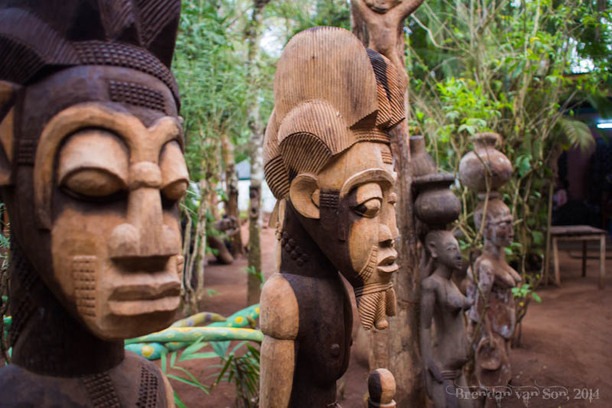
Kandi
Kandi, capital of Alibori in northeastern Bénin, is a lively Sahelian commercial hub. Central market, earthen mosques and gateway to W National Park.
Kandi is the main city in northeastern Bénin, capital of Alibori Department. A commercial crossroads between Bénin, Niger and Nigeria, it stands as the gateway to W National Park and the Sahelian plains. Its bustling market, mosques and Fulani and Dendi atmosphere make it an authentic stop well away from conventional tourist circuits.
Practical information at a glance
- Access: Kandi sits on National Route 2 (RN2), roughly 650 km north of Cotonou; buses and shared taxis from Parakou (around 200 km to the south).
- Recommended duration: a full day for the market, city and immediate surroundings; two days if you combine with W National Park.
- Dress code: covered clothing recommended in neighborhoods with large Muslim populations and at mosque entrances.
- Language: French, Dendi, Fulani (Fulfulde); basic knowledge of Dendi facilitates exchanges at the market.
What to see
Kandi's central market is the heart of the city. Livestock, grains, spices and textiles flow through here from surrounding villages and neighboring countries. The earthen mosques in the city center showcase the Sudano-Sahelian architecture characteristic of northern Bénin. The city's outskirts offer wooded savanna landscapes typical of the Sudanian zone.
History and context
Kandi developed as a trading post on caravan routes linking the Sahel to the Atlantic coast. The city long served as a meeting point between Dendi, Fulani and Bariba peoples. Under French colonization, it became an administrative center in northern Dahomey. Today, it remains the primary economic hub of Alibori, Bénin's largest department.
Highlights of a visit
The central market
Kandi's market is among the most active in northern Bénin. On major market days, Fulani herders bring their cattle, Nigerien merchants their spices and local artisans their basketwork. The atmosphere is dense, colorful and strikingly different from coastal markets.
The earthen mosques
Several mosques built from sun-dried earth dot the city center. Their sober architecture, with conical minarets and thick walls, is directly inherited from West African Sahelian building traditions. Some are open to non-Muslims outside prayer times.
The surrounding savanna
Beyond Kandi, the wooded savanna with shea and locust bean trees offers open landscapes characteristic of the region. In the dry season, the ochre tones and low morning light are particularly photogenic.
Etiquette and visiting rules
- Always ask permission before photographing people, especially women.
- Remove your shoes before entering a mosque.
- Avoid visiting mosques during prayer times (five times daily).
- Dress in covered clothing (shoulders and knees) in places of worship and residential neighborhoods.
Photography tips
Early morning light (before 9 a.m.) is ideal for photographing the market and earthen mosques, whose textures stand out beautifully in low-angle light. In the dry season (November-February), the harmattan haze may veil horizons but lends a distinctive atmosphere to portraits. Avoid photographing official and military buildings.
Location and access
Kandi is located in Alibori Department, in the far northeast of Bénin. RN2 connects it to Parakou to the south and Malanville (Niger border) to the north. Shared taxis and minibuses regularly serve these routes. The city has a small airport, but regular commercial connections are non-existent or highly irregular—verify before planning. Accessibility for those with mobility issues remains limited due to unpaved streets in outlying neighborhoods.
Nearby
- W National Park — transnational reserve (Bénin, Niger, Burkina Faso) home to elephants, lions and hippopotamuses; Kandi is one of the main logistics bases for access.
- Parakou — Bénin's second city, roughly 200 km to the south, with an international market and connections to Cotonou.
- Malanville — border town to the north, known for its major regional market attracting traders from Niger, Nigeria and Bénin.
Frequently asked questions
The dry season, from November to February, is the most pleasant: manageable temperatures in the morning, passable roads. Avoid July-September (rainy season) when some tracks to W National Park become impassable.
Some mosques welcome non-Muslim visitors outside prayer times, provided you remove your shoes, dress appropriately and request permission at the entrance. Nothing is automatic: inquire on site.
Yes, Kandi is one of the closest towns to the park on the Bénin side. Guides and 4×4 vehicles can be arranged there, but plan your logistics in advance as tourist services remain limited.
The route via Parakou (RN2) is the standard journey. Bus companies connect Cotonou to Parakou, then shared taxis provide service to Kandi. Plan for a full day of travel overall.
Kandi has a few modest inns and hotels suited for travelers passing through. Comfort remains basic; for more developed accommodation, Parakou offers more options.
Want to discover this destination?
Our local advisors design your tailor-made trip.