EGUNGUN DANCE
EGUNGUN DANCE
A sacred ceremony of ancestral masks in the Vodoun pantheon, Egungun dance is performed in Ouidah, the spiritual capital of Beninese Vodoun. Origins, rituals and tips for attendance.
Egungun dance is a sacred ceremony of the Vodoun pantheon, practiced by Yoruba and Nago communities in Benin and Nigeria. In Ouidah, the spiritual capital of Beninese Vodoun, it stages masked "revenants" who, according to belief, embody the spirits of ancestors returned among the living. It is one of the most striking ritual manifestations in the country's south, simultaneously a dance performance, a religious act, and an expression of a singular relationship with death.
Why Attend an Egungun Procession
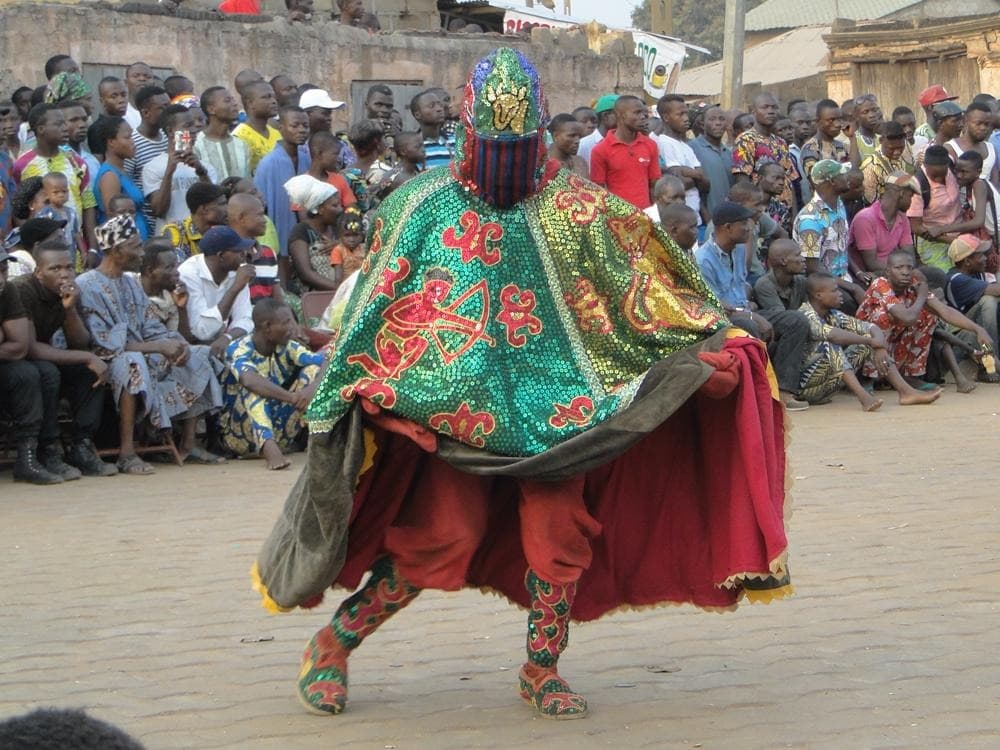
Unlike other traditional dances open to the general public, Egungun remains a rite with strong spiritual weight. The masks, adorned with layered colored fabrics, cowries, brilliantines, and sometimes gloves holding sharp objects evoking war, are not perceived as costumes but as presences. For the initiated, these are the dead themselves coming to dance. Senegalese poet Birago Diop captured this in verses often cited regarding these traditions:
"Those who are dead are never gone: / They are in the shade that grows bright / And in the shade that deepens."
Attending an Egungun procession means observing a system of thought where the boundary between the living and the dead is permeable, and where the community actively maintains dialogue with its ancestors.
History and Origins of the Egungun Tradition
Oral tradition traces Egungun dance to the city of Oyo in present-day southwestern Nigeria, the historic heart of Yoruba culture. Its arrival in Dahomey (the former name of Benin) is associated with the reign of King Guézo, who is said to have purchased enslaved people from Nigeria at that time. According to the transmitted account, during a celebration, one of these captives struck the ground with a staff and brought forth the Egungun, the revenants, accompanied by incantations. Impressed, the king allegedly had these men sent to Ouidah to establish the sanctuary of the Egungun there.
The term Egungun literally means "revenants" in Yoruba: it designates the incarnation of the dead who return to manifest themselves to the living. The tradition took firm root in southern Benin, where it constitutes today a cultural heritage shared with neighboring Nigeria. The practices of Egungun masks are recognized within the intangible cultural heritage field of the Yoruba area—a lineage to be presented with caution, as UNESCO inscription concerns primarily the related ritual of Gelede.
What You See During the Ceremony
The Masks and Their Attributes
The Egungun appear covered from head to foot: not a centimeter of skin must be visible. Their garments are adorned with brilliantines, cowries, and gloves; some hold sharp objects in hand symbolizing war. The layered wrapper skirts spin with each dance movement.
The Sequence of Events
The masks emerge from the shrine—a space reserved for the initiated—after a series of preparatory ceremonies. They communicate in Yoruba, execute choreography rhythmed by drums, and interact with the crowd, sometimes in playful fright. Egungun dance is notably performed at the death of a shrine chief or religious dignitary, and during major traditional festivals.
The Central Prohibition
The wrapper or garment of the revenant must under no circumstances touch a non-initiate. Legend states that contact can bring death on the spot, madness, or severe consequences. This is why each Egungun is accompanied by an initiated guide wielding a sacred staff, who opens the space, maintains public distance, and keeps the floating sides of costumes clear. Follow his directions imperative.
When to Witness Egungun Dance
Processions are not scheduled in advance like a tourist show: they depend on the ritual calendar of the shrines. Two occasions, however, significantly increase the chances of seeing one:
- The Vodoun Festival, celebrated every January 10th in Benin, particularly in Ouidah, which brings together many brotherhoods and features several masked processions in a single day.
- Funeral ceremonies of a shrine chief or religious dignitary, as well as certain large-scale community celebrations.
Outside these windows, spotting a procession requires going through a local guide connected with the shrines.
Practical Information
- Where: primarily in Ouidah and surrounding villages in southern Benin, where Egungun sanctuaries have been active since the 19th century.
- How: working with an initiated guide or local escort familiar with the shrines is essential, both to spot a ceremony and to respect the codes.
- Attire: modest, neutral clothing; avoid bright colors that could be interpreted as provocation.
- Photography: systematically ask the initiated guide for permission before filming or photographing; certain masks forbid it.
- Posture: keep your distance, never attempt to touch the costume, do not cross the perimeter indicated by the guide's staff.
- Duration: generally plan for one to two hours on-site, sometimes longer during major festivals.
What to Combine Nearby
Ouidah concentrates much of Benin's Vodoun heritage and lends itself to a stay of several days:
- The Slave Route, a memorial journey connecting the former slave market to the Gate of No Return on the beach.
- The Sacred Forest Kpassè Zoun, an emblematic ritual site of Vodoun cosmogony.
- The Mono River, natural border with Togo, to extend exploration westward.
- Songhaï Center in Porto-Novo, for a contemporary reading of agricultural Benin.
Frequently Asked Questions
Frequently asked questions
Egungun means "revenants" in Yoruba. The term designates the incarnation of the dead who return to manifest themselves to the living through ritual masks.
Yes, the public can observe public processions, but at a distance. Ceremonies internal to the shrine remain reserved for the initiated. The absolute rule is never to let the revenant's costume come into contact with you.
According to belief, contact with a non-initiate can cause death, madness, or severe consequences. An initiated guide armed with a sacred staff thus accompanies each mask to maintain distance.
Every January 10th, a public holiday in Benin. Ouidah is its epicenter and one of the best opportunities to see Egungun processions.
The Yoruba cultural area to which Egungun belongs is associated with several traditions recognized as intangible cultural heritage, notably the related ritual of Gelede. The specific status of Egungun masks varies by source: best verified locally.
Preparing Your Trip to Benin
To integrate an Egungun ceremony into an itinerary respectful of local traditions, the guidance of a guide connected with the shrines is essential. Discover our tailor-made itineraries in our Benin travel guide.
Interested in this visit?
We can include it in your personalised itinerary.