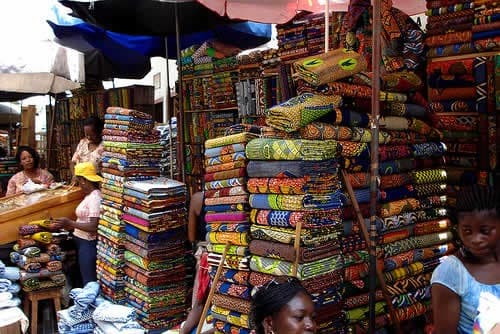
Assiganme Market
Assiganme Market
In the heart of Lomé, Assiganme market concentrates the textile and food trade of Togo's capital, following in the footsteps of the famous Nana Benz.
In the center of Lomé, capital of Togo, Assiganme market—often called Grand Marché de Lomé—concentrates a significant portion of the city's daily commerce. Located just steps from the Sacred Heart Cathedral, it centers around a main building and spills onto the surrounding streets, where merchants set up their stalls at dawn.
Why visit Assiganme market
Assiganme is not a museumified attraction: it is a living workspace, visited daily by locals seeking supplies of cloth, groceries, and manufactured goods. For visitors, the interest is twofold.
- Understanding Togolese grassroots economy by observing an urban market still largely operated by women.
- Experiencing wax culture up close: printed fabrics, coded patterns, meter-by-meter negotiations.
- Grasping the atmosphere of a West African capital, dense, sonorous, organized by product category (textiles, food, cosmetics, household items).
A legacy of the Nana Benz
Assiganme market owes its reputation to a generation of Togolese businesswomen known as the Nana Benz. From the 1950s through the 1970s, these women built fortunes on importing and reselling wax cloth, primarily manufactured in the Netherlands by the Vlisco company. The nickname came from the Mercedes-Benz automobiles they acquired at the height of their success, a testament to their standing in the national economy.
For several decades, the Nana Benz dictated wax trends across West Africa: fabric selection, textile naming, and release schedules. Their daughters and granddaughters, sometimes called "Nanettes," carried on the legacy with business models adapted to competition from Asian textiles. This history remains central to understanding Assiganme today: the market is not simply a retail hub, but the birthplace of a female entrepreneurial figure recognized throughout the sub-region.
What to see and do
The central building and textile floors
The heart of the market houses cloth stalls. The merchants, dressed in vibrant traditional attire, display fabrics folded into tidy stacks. The patterns carry evocative names—proverbs, events, tributes—that form part of Togolese textile heritage.
The surrounding streets
Around the main building, the alleys are specialized: fresh produce and spices on one side, kitchen utensils, notions, traditional cosmetics, and ritual objects on the other. This is also where porters and carts move about, handling the market's logistics.
Scenes of daily life
Preparing take-away meals, morning deliveries, negotiations between wholesalers and retailers: Assiganme reads as an economic system in motion. An attentive visit reveals the hierarchies between established merchants and mobile vendors.
Practical information
- Operating hours: the market runs Monday to Saturday, with peak activity in the morning. Activity drops significantly on Sunday.
- Duration of visit: plan 1 to 2 hours for a browsing tour, longer if you are buying fabric and negotiating cuts.
- Photography: always ask permission before photographing a merchant or stall. Many refuse; some accept in exchange for a small purchase.
- Safety: the crowds are dense; keep valuables close to your body and minimize visible items.
- Payment: bring cash in CFA francs, in small denominations for everyday purchases.
How to get there
Assiganme market is located in Lomé's administrative and commercial center, directly adjacent to the Sacred Heart Cathedral, which serves as a landmark. From the waterfront (boulevard du Mono), it is reachable on foot in about ten minutes. Shared taxis and motorcycle taxis ("zémidjans") service the area continuously; tell the driver "Grand Marché," the more commonly used term than the official name. It is best to be dropped off a street away from the market itself, as the immediate approach is often congested.
Nearby attractions
- Sacred Heart Cathedral of Lomé: a red-brick building, the market's direct neighbor.
- Fetish Market (Akodessewa): east of Lomé, dedicated to ritual objects of vodou.
- Wome Waterfalls: a day trip from the capital, in the Kpalimé region.
- Mont Agou: Togo's highest point, also accessible from Lomé.
Frequently asked questions
Frequently asked questions
The market is active Monday to Saturday, with peak activity in the morning. On Sunday, most stalls remain closed.
Yes. Merchants offer both imported wax (notably Vlisco) and more affordable imitations. Ask about the fabric's origin and inspect print quality before purchasing.
Negotiation is expected on most items, particularly textiles. Remain courteous and only engage in discussion if you intend to buy.
Integrating Assiganme into your trip
The market fits naturally into a one- to two-day discovery of Lomé, before continuing toward the Kpalimé region or the coast. To build an itinerary through Togo that includes the capital, its markets, and the hinterland, see our Togo tours.
Interested in this visit?
We can include it in your personalised itinerary.