Knife Dance
Knife Dance
Spectacular ritual of the Traoré, Touré, Mendè, Cissé and Fofana clans in the Didaouré district of Sokodé, following the Islamic lunar calendar.
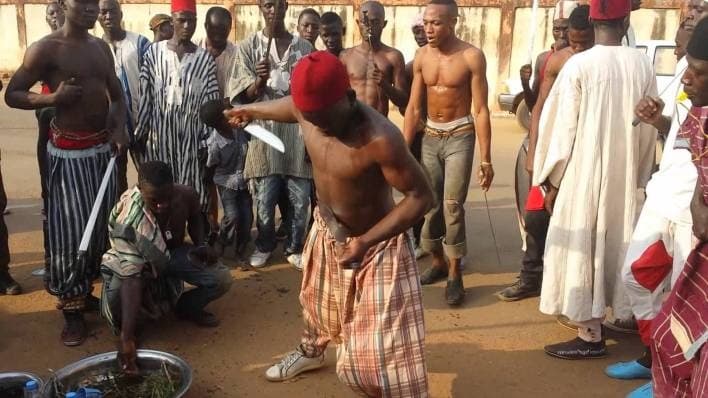
The knife dance is a traditional performance practiced in Sokodé, in the Central region of Togo. Executed by several clans settled in the Didaouré district, it follows the Islamic lunar calendar and stands as one of the highlights of tem-kotokoli culture. Each year, it brings together notables, elders, administrative authorities, residents and travelers to witness a spectacular ritual where the blade does not wound the dancers' skin.
Why witness the knife dance
This ceremony is far more than mere folklore. It embodies knowledge passed down through generations, where physical mastery, trance and spiritual dimension converge. The dancers wield sharp blades to the rhythm of drums, striking their chests and limbs without leaving visible wounds — a phenomenon attributed to ritual practices and mystical protection inherent to the clans involved.
For the traveler, it is an opportunity to observe a living expression of West African Sufi Islam, intimately woven with local traditions. The performance unfolds in the open air, surrounded by a dense crowd, in an atmosphere both meditative and electric.
History and clans keeping the tradition alive
The knife dance is performed by the clans Traoré, Touré, Mendè, Cissé and Fofana, who inhabit the Didaouré district of Sokodé, in northern Togo. These families, of Mandingo origin, have preserved a ritual heritage that links the Muslim tem community to ancient practices of bodily protection.
The ceremony takes place during the third month of the Islamic lunar year, a period associated with major religious commemorations. Over the decades, the event has become renowned far beyond Sokodé and now attracts curious onlookers as well as anthropology researchers.
A transmission from clan to clan
Only initiates from the five clans mentioned are permitted to dance and wield the blades. Transmission occurs through family lineage, following an apprenticeship that blends choreography, recitations and ritual preparation. This exclusivity explains why the dance is not reproduced elsewhere in Togo in the same form.
What you will witness
- Dancers in trance : shirtless, they spin to the rhythm of percussion and strike their bodies with sharpened knives and swords.
- The traditional orchestra : drums, flutes and singing punctuate the ceremony and accompany the trance phases.
- Ritual attire : loincloths, amulets and headdresses specific to each clan, laden with symbolic meaning.
- The mingled crowd : administrative authorities, traditional leaders, Sokodé families and visitors form a dense audience around the dancers.
- Demonstrations of protection : moments when the blades pass over skin without wounding it, the climax of the performance.
When to attend
The knife dance follows the Islamic lunar calendar and is held during the third month (Rabi al-Awwal). The date therefore varies each year in the Gregorian calendar, shifting back by approximately eleven days year to year. Before planning your trip, check with Sokodé's local authorities or your travel agent to confirm the exact date.
The dry season, from November to February, remains the most comfortable period for traveling in central Togo : manageable temperatures, passable tracks and drier air despite the harmattan winds.
Practical information
- Location : Didaouré district, in Sokodé, Central region of Togo.
- Access : Sokodé is located approximately 340 km north of Lomé, accessible via national road 1.
- Duration : allow half a day to a full day to witness the complete ritual and its preparations.
- Admission : the event is open to the public, though a contribution or local guide is recommended to understand the proceedings.
- Photography and video : request permission before taking any photographs or filming, as certain ritual moments are not intended to be recorded.
- Dress code : wear modest, covering clothing out of respect for the event's religious character.
What to see around Sokodé
Make the most of your time in the Central region by extending your discovery of Togo's cultural and natural heritage :
- Sokodé : crossroads city of the north, capital of tem-kotokoli culture.
- Evala : Kabyè initiation wrestling, another major traditional gathering of northern Togo.
- Mont Agou : the country's highest peak, in the southwest, for a nature-focused stopover.
- Fetish Market : to understand the vodun dimension of Togolese culture.
- Wome Waterfalls : a refreshing stop in Ewe country.
Planning your journey
The knife dance deserves to be woven into a broader itinerary across Togo, combining the Islamic culture of the center, animist traditions of the south and diverse landscapes. To craft a tailor-made trip including Sokodé and its ceremonies, explore our journeys through Togo.
Interested in this visit?
We can include it in your personalised itinerary.