Benin Destination: A Growing Passion for Thematic Tourism
Located in West Africa within the tropical zone between the equator and the Tropic of Cancer, Benin is bordered to the north by the Niger River, which separates it from the Republic of Niger.
Located in West Africa within the tropical zone between the equator and the Tropic of Cancer, Benin is bordered to the north by the Niger River, which separates it from the Republic of Niger. To the northwest, it is bordered by Burkina Faso, to the west by Togo, to the east by Nigeria, and to the south by the Atlantic Ocean. Benin, a land of culture and tourism riches, is a melting pot of cultures. It perpetuates a rich centuries-old cultural tradition.
The Beninese cultural heritage encompasses monuments and sites of all kinds: Royal Palaces, Traditional Dwellings, Temples and sacred forests, Ancient Forts and trading posts, Afro-Brazilian and colonial buildings, etc. In former Dahomey, colonial administrators had already noticed and rudimentarily developed certain sites, such as Grand-Popo, the Mouth of the Roy (estuary of the Mono River) or Ganvié. But recently, a new highly ambitious tourism project has emerged thanks to the tourism agency ''VOYAGES MODESTES''.
''VOYAGES MODESTES'' is based in Benin and specializes in tourism across English-speaking Africa. It organizes tourist stays with efficiency and passion. Particular emphasis is placed on bringing people together, and thus on tourism on a human scale with prices that defy competition. It is an agency that brings together the necessary and essential skills in the field of Tourism and Culture. This fusion of Tourism + Culture is the culmination of a very broad opening project to Beninese and foreign audiences. The objective of this organization is simple: to create beautiful encounters that renew the format of the usual cultural visit, rather reserved for an elite of connoisseurs. For years, the ''VOYAGES MODESTES'' agency has worked to highlight Benin's tourism potential. It offers visitors a thousand and one reasons to explore Benin in its rich cultural diversity.
Benin, Enormous Tourism Potential
Benin possesses multiple and still-functional cultural heritage. The country is a concentration of everything Africa has to offer: sun, fine sandy beaches, ocean, natural parks, mountains, lakes, villages, ethnic groups, wild fauna and flora. Nevertheless, what makes the essence of Benin as a destination is its historical, aesthetic, artistic, and cultural heritage. A unique heritage that has been able to spread throughout the world through rhythms, traditional dances, and Vodou, the ancestral religion of Danxomè.
What Can Be Done to Make Visible What Remains Hidden?
'VOYAGES MODESTES' extends us into the heart of a tourist journey into the universe of traditional rhythms and dances of Benin's rich heritage. Benin is one of the rare African countries where traditional rhythms and dances play a predominant role in daily life. This diversity of traditional rhythms fits into the logic of ethnic groupings and geographical areas. The most important ones are Zinli - Akinta and Akohoun – Tchinkoumè – Toba – Agboutchebou – Kpanahoun. They are valued in various ways and constitute the first sources of joy according to the regions. Benin is a country renowned for its bodily expressions through songs and dances linked to sources of royalty. The great diversity of religious and ritual dances also contributes to Benin's cultural richness. Highly complex and surprisingly expressive, these traditional choreographies are performed on the occasion of very particular festivities such as the Gani, which brings together the Baatombu community, but also during numerous impromptu celebrations. This is what encourages travelers from various horizons to come and watch whenever the occasion presents itself. The country also surprises with its cultural diversity expressed through cults and traditions unique to each ethnic group. Generally speaking, in Benin traditional dance is performed with the shoulders and torso. Besides the fact that traditional dance is practiced differently from north to south in Benin, however, whatever the region of Benin.
Which Traditional Cultural Dances Still Resist the Test of Time?
We can classify Beninese dances into three categories, namely:
Celebration Dances: These African dances are performed during various ceremonies or rituals such as weddings, births, and most events that punctuate daily life in Benin. Depending on the regions of Benin, we find: Massé gohoun, Adjogbo, Agbadja, Kaka, Kunya, Tipinti, Fabenfé, Atchanoun, Sinssinnou. Royal Dances: These traditional dances relate to divinities and speak of them. We have Klulima, Idjombi, Houngan, Sato, Blékété, Chasseur, Adjogan, Linsouhoué, Agbéhoun, Kpodjiguêguê, Guêlêdê, Abikou, Têkê, Tchinkounmè, Zinlin, Zangbéto, Bourian. Vodou Dances: These are sacred, wild, multicolored, moving dances that evoke the various divinities responsible for the sky, earth, air, happiness, etc. These African vodou dances are titled: Sakpata, Hêviosso, Tchango, Egoun-goun, Dan, Kokou, Ganbada. The country consists of two geographical areas: The north, which experienced the fate of savanna peoples. The south and center of the country, which are marked by the history of peoples of the Gulf of Guinea. Until the 15th century, many savanna peoples settled in the north: Bariba or Baatombu, Dendi, Djerma, Groussi, Haoussa, Mossi, Paragourma, and Peuls. While coastal populations settled in the south and center: Fon and Aja or Adja, Ewé, Gen, Mina, and Yoruba.
Where Do These Rhythms Come From?
The African dance of Benin is greatly influenced by its origins. From north to south in Benin, this is evident in celebration dances. The Massé gohoun dance originates in Avrankou, a region in western Benin a few kilometers from Porto-Novo. This dance draws inspiration from scenes of daily life: eating, quarreling, having fun, working, and taking time to savor life. It is a particularly lively dance. African dances originating from southern Benin: The Adjogbo, the Agbadja, and the Atchanhoun. The Adjogbo was originally a funeral dance, but is also performed during celebrations. This African dance is highly choreographed, with dancers executing synchronized and sometimes acrobatic movements. The Agbadja was originally a dance of fishermen from Ghana who would gather after a long day's work. This dance is alternately slow, light, then brutal and energetic. It is performed with strong shoulder movements. The Atchanoun is a dance performed after harvests. In the OUENE region (on the Niger border): the Kaka dance. The Kaka is both a celebration dance and a ritual dance, performed with pieces of bamboo tapped against each other to create rhythm. The dancer is simultaneously the player of this musical instrument.
Heading toward northern Benin in the Atacora region, we can speak of: The Tipinti: dancers dress in small skirts made of beads and wear a belt of bells around the ankle. This dance is performed at the end of arduous work harvesting millet and sorghum. In the Parakou region and (heading toward northern Benin), the Tèkè dance. This rhythm is also called ''the stick dance'' because it is performed with two sticks in hand. The sound produced by the two sticks tapping against each other is what makes this dance unique. The dancer is dressed either in a ''chaya'' or in a skirt made of several wrapped cloths with a turbaned head. It is performed very slowly. In northwestern Benin, the Kunya is a dance from the Toukountouna region. The Waama people perform it during festive ceremonial events. This traditional folk dance is performed exclusively by women, in a circle, who, after dressing themselves beautifully, tie cloths at the waist or wear small skirts and remain almost half-dressed to perform it. This dance is accompanied by movements of body agitation and especially hands in almost all directions. This rhythm is accompanied by hand clapping and instruments such as tom-toms and whistles. If the assertion of cultural identities conditions all development, Beninese traditional dances still play a predominant role in the structure of this highly diversified society.
With Which Agency and How to Organize a Thematic Trip to Benin?
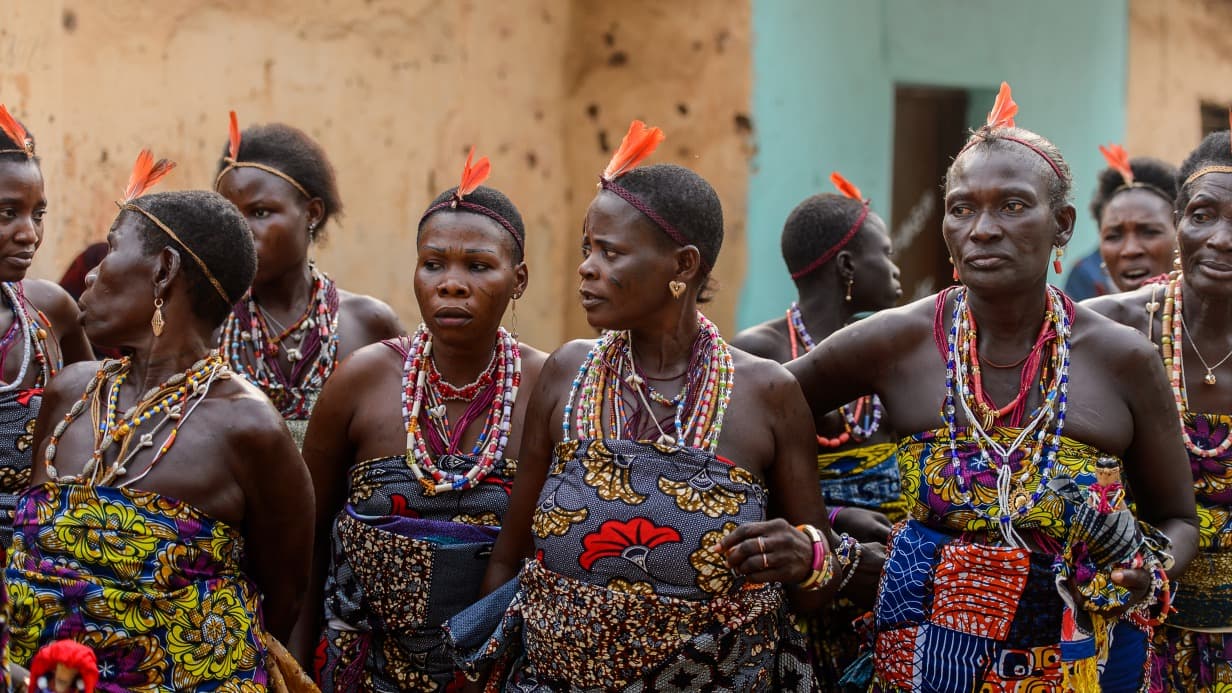
''VOYAGES MODESTES'' can take charge during your trip of organizing a traditional dance show that will make you experience the enchanting rhythm of Benin's traditions. Our final stop will be in the mystical world of vodou worship. Today, the secret of this vodou cult remains intact and jealously maintained by the guardians of tradition. Benin is considered the cradle of Vodoun, and more than half of Benin's population practices this traditional religion, which some also call Animism. This animistic cult remains very vibrant in the country today. Numerous ritual ceremonies are accompanied by singing, drum beatings, dances, prayers, and offerings to fetishes. These practices have been rooted in the traditions of peoples for centuries, and for many tourists, they constitute one of the most interesting aspects of culture to explore. This animistic cult remains very vibrant in the country today. Numerous ritual ceremonies are accompanied by singing, drum beatings, dances, prayers, and offerings to fetishes. The individual's connection with vodoun divinities manifests itself through trances, one of the most spectacular aspects of this cult. Today, cultural and religious practices linked to vodoun are found in most countries populated by people of African descent: Brazil, USA, Haiti, Cuba, etc. There are followers of Hêviosso, god of thunder, of Sakapta, god of the earth, of Mami Wata, goddess of the waters, of Gambada, a god who brings wealth. There are also the impressive Zangbeto, guardians of the night. The vodounsi, the name given to initiates, dance to the sound of tom-toms and gongs, following rhythms specific to each divinity. These men, women, and young people are recognizable by their cloths and their ornaments of necklaces and bracelets, also specific to each cult. While the religion is ancestral, the vodoun festival is recent in Benin. It was established in 1994 by former president Nicéphore Soglo, then transformed into a public holiday in 1998 under Mathieu Kérékou. A national celebration held every 10th of January throughout the territory for what is a religion in this country where voodoo was born. This religion is built around spirits of nature (water, fire, air, earth) and ancestors, called ''vodoun''. It is an opportunity for followers to gather, bring out their divinities, and dance. The vodoun are spirits that are everywhere. Through these divinized spirits, gathered in a vodou pantheon, initiates communicate with God, a creator God who is above all.
Sacred Masks: What Meaning in the Daily Lives of Beninese?
To visit Benin and deprive yourself of the spectacles of sacred masks like the ZANGBETO, the egoun-goun, the guèllèdè is to miss discovering another facet of this cultural richness that the country possesses.
The Zangbéto is a mask introduced into the kingdom of Xogbonou, today PORTO-NOVO, by the first sovereign, Tè-Agbanlin. Its physical appearance presents a mask of plant material often of conical form. During the night, it plays the role of guardian and ensures the security of the city. It settles social conflicts and manages environmental or deviance issues. According to oral tradition, the ''Zangbéto'' would be a brilliant idea of the founder of the kingdom of Hogbonou, aided by his older brother, to keep wild beasts away from the surroundings of their dwelling through the frightening noise produced by this mask. The ''Zangbéto'' form a secret initiation society whose chief is the ''Kpakri Yawo'', ''Zangbéto'' installed in Avassa near the ''Honmè'' palace. During the night, it plays the role of guardian and ensures security and order in the city. The music accompanying the ''Zangbéto'' is the ''Gansou'' or the ''Kaka''. The ''Gansou'' (large gong) is played with the gong and scrap metal in a very deafening noise. The Kaka or wood rhythm is music made of wood tapping.
Our next stop is in front of the convent of the returned spirits in OUIDAH. Also called kouvito in the local Fongbé language or egoun-goun in Yoruba language, the egoun-goun mask is dedicated to the deceased. It is reserved for men, assisted by an elderly woman with extraordinary powers. The Egoun-goun is a cult of Yoruba origin. It represents communion between the living and the ancestors. It found itself in the Adja-Tado area as a result of military victories or alliances with neighboring groups according to the dynamics of accumulating powers and appropriating the religious forces of others. It is often linked to a divinity. It is the divinity par excellence of the cult. It is powerful and highly venerated. From the Zangbeto and Égoun-goun masks to the Guèlèdè, there is just a step. This mask can be sought by women according to their needs as it has the power to grant their requests for procreation.
The Gèlèdè, a Celebration of Identity
The Gèlèdè is a mixed society in which women play an important role in both major decisions and minor details. Women are placed below men in the chain of command but are often in harmony with them. The Gèlèdè (pronounced Guèlèdè) is characterized by spectacular costumes. These are masks representing women but worn by men. The mask emerges to resolve individual, family issues (infertility, illness, death, curses...) or collective matters such as natural calamities. It can also be admired during important events: weddings, inaugurations.
These potentials are found, in greater or lesser numbers, in most localities of our country that the ''VOYAGES MODESTES'' tourism agency makes you explore. Their development allows for strengthening Benin's tourism offerings in both quality and quantity.
In view of the tourism resources that Benin possesses, the political stability and social peace that prevail there, the improvement in the business climate, many opportunities present themselves for the development of tourism through the development of our tourism riches to strengthen and diversify the products composing the current offering, taking into account the strengths and weaknesses of opportunities and constraints of said offering for the launch of new tourism products or complementary products.